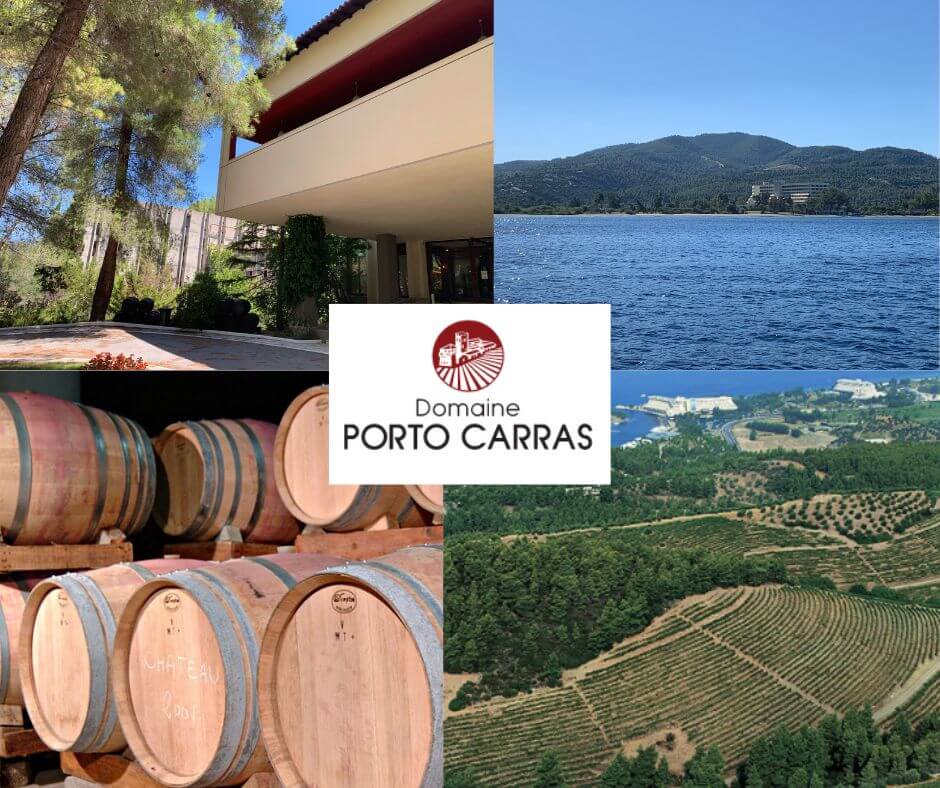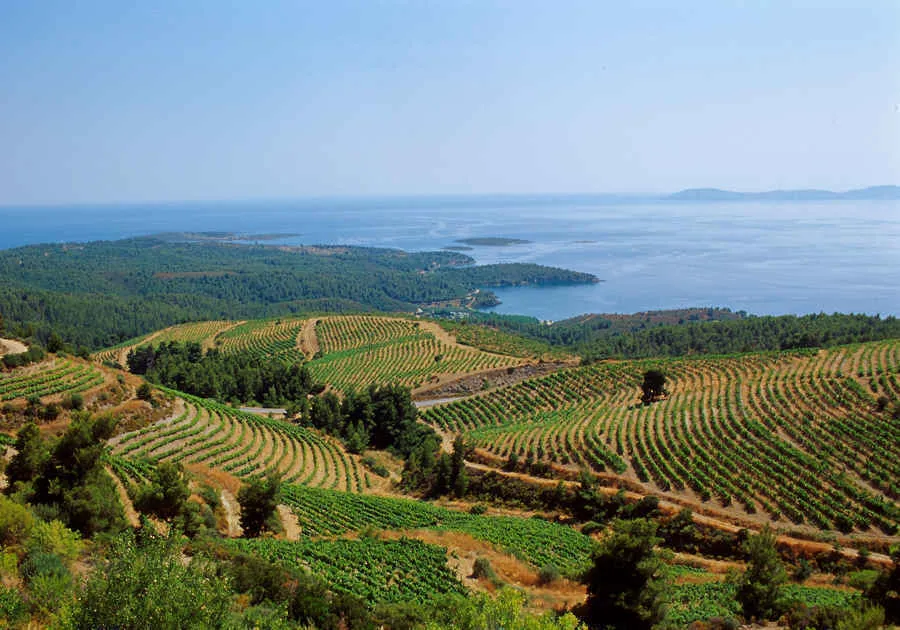
Have you ever heard of the Greek PDO (Protected Designation of Origin) Meliton Slopes? You are not alone if you say no. This little known gem is home to winery Porto Carras. The 450 hectare (1,100 acres) agricultural haven is home to grapevines and olive trees that flourish with ease.
I recently had the opportunity to spend some time in the Sithonia Peninsula, where Meliton Slopes is found. It is important to stop and note here that Domaine Porto Carras is the only winery in the PDO, giving it control of the designation’s expression to some extent and therefore great responsibility.
“For us in Porto Carras, being the only winery [and] producer, the PDO Slopes of Meliton means an even greater responsibility to maintain the quality of our wines at a very high level, worthy of a PDO.”~ Dr. Haroula Spinthiropoulou, Chief Agronomist at Domaine Porto Carras
Exploration of the Porto Carras vineyards (Greece’s largest organic vineyard) and a deep dive tasting with the winemaker left me motivated to come away and share as much of their story as possible with you.
With that being said, so much content is not included here, such as their commitment to further winery transformations that are the first of their kind, and their strong female leadership, oenology, and winery team that is doing things to blow your mind. Instead, I will give you just enough information to get you curious and excited about all Domaine Porto Carras offers. Let’s go.
Early Providence
The Domaine Porto Carras design and plantings are the results of a think tank led by, then owner, Yannis Carras, and made up of Agronomy Professors from the local university and wine authorities.
The think tank study looked at which varieties would thrive in the area, not just grapes native to Greece but also international grapes. This attention to the environment and analysis of the soils in 1965 led to the vineyard layout and vines we see today.
Vines are planted in an amphitheatre style, and the dense forestry footprint that surrounds the vines studiously traps that humidity making this hilly vineyard landscape a bit of its own mesoclimate. Though the area goes for an extended period of time without rainfall, Porto Carras vineyard soils remain lush.
The study of the land pointed Porto Carras to include foreign varieties in their vineyards, making them the first to do so in Greece. The foreign varieties include Sauvignon Blanc, Cabernet Sauvignon, Cabernet Franc, Merlot, and Syrah. In fact, Syrah thrives here.
“Porto Carras is made for Syrah” says winemaker Froso Drossou, and I couldn’t agree more. Take a look at the wine notes below to see how much their 2009 and 2005 Syrah’s had me mesmerised. These foreign varieties exist amongst a slew of brilliant native grapes that we would no longer have if not for Porto Carras (see Driven by History).
Today, the Domaine cultivates 26 grape varieties in support of their single variety and blended wine programs.
Driven by History
In their land survey, not only was it essential to consider the popular native grapes being grown in Greece for profitability, plus international varieties, but it was also crucial for Domaine Porto Carras to pay homage to yesterday. As a result, their early vineyard program included reviving the historied Greek grapes, Malagousia (Malagouzia), and Limnio.
Malagousia, an aromatic, bright white wine, was nearly extinct at the point of plantings at the Domaine. Porto Carras is recognized as a critical player in bringing back this now popular grape in many texts and authoritative publications.
Malagousia is a difficult grape to grow and requires more attention than other vines in the vineyard in order to produce a great wine. The difficulty in managing Malagousia in the vineyard could be what led to its near extinct status after World War II.
Limnio, a red grape and the other revived variety from Porto Carras, is said to be one of Greece’s oldest cultivated wines. You can find inference to it in stories about the Greek god Dionysus and in the writings of Aristotle. Despite its formidable historical presence, the wine quickly fell out of favour.
Since the time of Porto Carras’ Limnio project, you are seeing more and more wineries include this grape in their, what I like to call, homage lines of wines.
In many ways, we have Domaine Porto Carras to thank for some of the most exciting wine projects coming out of Greece, with much more impressive show-and-tell moments to come.